
The summer of 2023 is not easily forgotten. Thermometers bursting, reservoirs half-empty, and the certainty—now beyond any doubt—that climate change is not some distant prospect, but something we experience every August. Against this backdrop, one statistic should make us sit up and take notice: searches for cooler destinations soared by 237% this summer.
A passing fad or the beginning of another way to travel? I see it more as a crack. People are looking for thermal relief, all right, but that same search can become a lever to do things differently.
Forecasts suggest that 2026 will be one of the hottest years ever recorded. With that horizon ahead, *coolcations* —holidays where the sun is less punishing— have ceased to be a curiosity and have established themselves as a trend. And what’s interesting isn’t the escape itself, but what we’re capable of posting about it.
Because escaping the heat can also be an excuse to reconnect with our surroundings, to spend money where it's truly needed, and to promote practices that care for the land instead of exploiting it. Catalonia, with the sheer variety of microclimates and landscapes packed into just a few kilometres, has a lot to offer here. We're not talking about manufacturing alternatives to overcrowded beaches; we're talking about designing experiences that leave a place better than they found it.
What the data shows:
Today, the Barcelona metropolitan area, which currently manages climate shelters to mitigate the effects of high summer temperatures, registered 15.1 °C; the Catalan Pyrenees, 7.6 °C. The air quality was identical in both areas — an AQI of 134 — and yet the experience is nothing alike. Added to all this is something that research has long been confirming: spending hours in nature lowers stress and is good for your head. Normal, right? Just thinking about a square in a city without trees already raises my temperature.
Plan with the weather, not just measure your carbon footprint
So that the Coolcations they need to be more than a marketing claim; genuine planning is required: one that looks at the specific risks of each territory and brings local communities to the decision-making table. We need to have public debates about the climate, to look at the risks… and the solutions.
A recent study insists on this point. Destinations that thrive are those that identify and address their climate risks before they hit investment, connectivity and costs. That means asking uncomfortable questions: will the tourism infrastructure hold up? Will there be enough water? What is lost to biodiversity along the way? Some are uncomfortable questions, I know, but it's no good hiding or ignoring them.
Scotland has long been answering these questions with a climate action plan on a local scale: fewer emissions, more resilience, and tourism that doesn't eat itself. It's not a model to be copied exactly, but it's a good indication of where to start. More clues.
UNESCO as a beacon for regenerative tourism
The spaces designated by UNESCO offer an almost ideal ground for marrying conservation and development. We are talking about very different landscapes – World Heritage sites, biosphere reserves, geoparks – all recognised for something worth preserving.
The figures are dizzying: over 2,260 designated areas, spread across more than 13 million square kilometres, supporting around 900 million people. They are proof, repeated over centuries, that communities and nature can grow and adapt at the same time, rather than at each other's expense.
What makes them valuable is not just their beauty, but how they are managed. I venture to say that the two things, beauty and management, have a lot in common. When a community truly participates in the tourism of their area — and the benefits return to conservation instead of evaporating — that tourism ceases to be a threat and becomes part of the solution.
The metric almost no one measures: Community wellbeing
Regenerative tourism is not exhausted by cutting emissions. Its true test lies in what it leaves behind: a stronger local economy, a culture that stays alive, an improved quality of life.
There appears a metric that is rarely discussed: community well-being. Does tourism improve the health, education, housing, and access to services of the people living in the destination? Does it reinforce their identity or dilute it? Does it empower them to make decisions about their own territory? These are the questions that should guide any tourism policy that takes itself seriously.
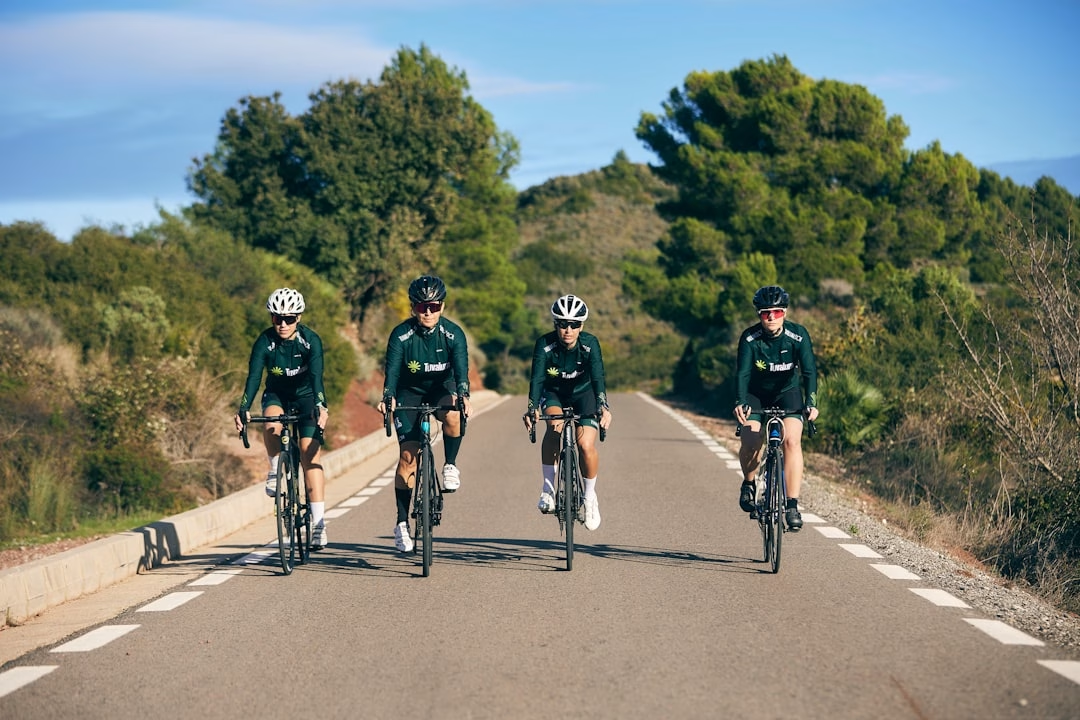
Regenebike, for example, measures the impact of its routes on the economy of each region: how much income stays in the territory, how much support cooperatives receive, how many decent jobs are created. And it also looks at governance, because without the communities having a voice and vote, the rest remains good intentions.
Fundamentally, climate action in tourism isn't just about emitting less CO₂. It's about changing the model: opting for a regenerative approach that benefits both the environment and those who inhabit it.
This week beginsFind out which organisations in your region work on ecological restoration and see how you can lend them a hand, with your time or your resources. Every bit of help counts, every action counts.
The heat is fierce. But the opportunity to act is even fiercer.
Leave a Reply
You must be logged in to post a comment.